
Texas Tea: A Q&A with Janet Nuzzie, Texas Council of Teachers on Mathematics
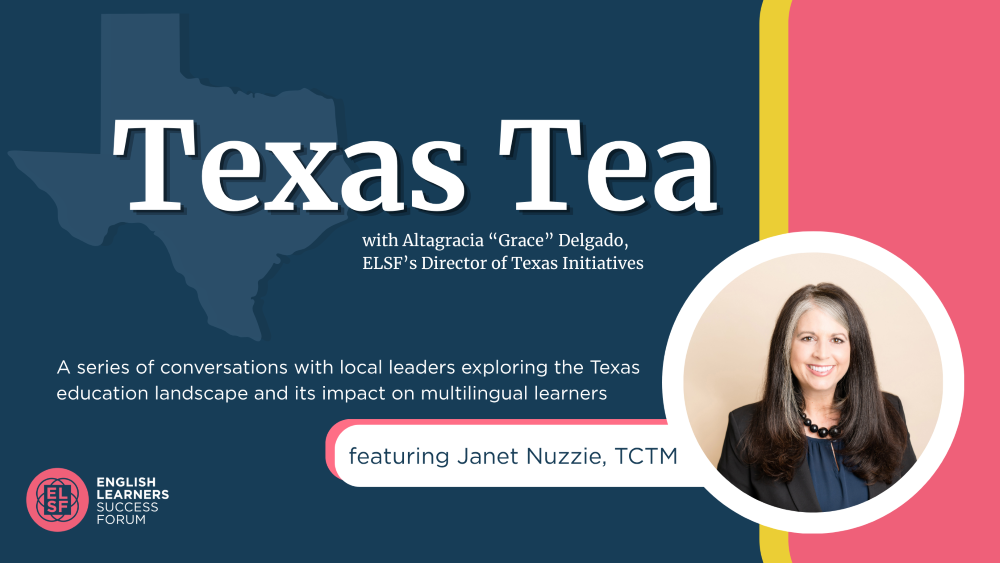
The educational environment in Texas is rapidly changing. Our "Texas Tea" series uplifts the voices of local Texas educators and leaders about the work they’re doing, the challenges they face, and how they’re navigating such a transformative time for the state.
Janet Nuzzie serves as the President of the Texas Council of Teachers on Mathematics and has spent many years developing her expertise as a leader in mathematics instruction and becoming an essential part of the Texas education landscape. She is currently the Pasadena Independent School District intervention specialist for K-12 mathematics. In this role, her responsibilities include facilitating a districtwide multitiered system of supports (MTSS) for students in need of intensive intervention in mathematics and providing professional development for campus leaders and teachers. Janet is a fierce advocate for high quality math instruction and a true ally to multilingual communities in Texas.
Janet recently spoke with ELSF’s Director of Texas Initiatives Altagracia “Grace” Delgado about mathematics instructional materials and how those responsible for curriculum adoption and implementation decisions can take advantage of this unique moment for Texas.
Texas is in a unique moment with instructional materials policy and adoption cycles. From your perspective, what makes this moment particularly important for mathematics education, and how should leaders be thinking about HQIM as part of that shift?
This moment signals a shift from the state towards quality and coherence. It presents an opportunity for all districts to work intentionally to ensure that instruction is aligned with the rigor of grade-level standards and facilitated in ways that ensure access and academic achievement for all students.
It also provides an opportunity for system-level change, clarity, and consistency.
Leaders should think of HQIM as a bridge between policy and practice, providing opportunities to increase teachers’ efficacy and confidence with pedagogical content knowledge.
During our January conversation, we discussed the growing focus on high-quality instructional materials. How would you define “quality” in math instructional materials?
There are many ways to define “quality” in mathematics instructional materials. For example, quality materials would be materials that are tightly aligned to the standards; use the stages of the instructional hierarchy in mathematics (acquisition, fluency, generalization/adaptation) to build conceptual understanding and procedural fluency; and incorporate purposeful spaced and interleaved practice with opportunities for feedback.
Quality instructional materials should include supports for diverse learners, including multilingual students. They should also provide well-designed, systematic lessons that feature explicit instruction to facilitate new knowledge and include strategic, efficient assessment systems.
What are some common misconceptions educators or leaders have when evaluating math curriculum, especially when it comes to rigor versus accessibility?
Misequating rigor with more or “harder” problems, devaluing the importance of productive struggle when students engage in rigorous tasks, and misinterpreting accessibility as simplifying the mathematics or lowering expectations of grade-level proficiency.
How can strong math materials actually serve as a lever for access, particularly for students who have historically been underserved in mathematics?
The materials should be aligned to grade-level content. The materials should promote consistency between classrooms, grade-levels, campuses, and districts in order to allow all students access to a “level” playing ground.
It’s also important that materials include supports for multilingual learners. This can look like visual models, sentence frames, discourse routines, and opportunities to share thinking that increase students’ proficiency with the grade-level standards.
Ultimately, materials serve as a lever for access when they allow more time for all students to engage in sense-making and reasoning. Quality materials help increase access when they engage students with direct, explicit instruction to introduce novice concepts and ensure that students transition between acquisition to fluency to generalization and adaptation - a key instructional hierarchy in mathematics.
Adoption is only the first step. What are the most critical conditions districts need to have in place to ensure the successful implementation of math HQIM?
The creation of a community of learners that have a clear and shared vision of what effective and evidence-based mathematics instruction looks like is critical. But that’s not enough. Consistent messaging of expectations among district leaders, campus leaders, and mathematics teachers as well as consistent and ongoing professional learning are also necessary to support the implementation of HQIM
Protected time for teacher teams to engage in collaborative planning conversations is another condition that must be in place. These conversations should be focused on the internalization of the lessons, the analysis of student data, and action planning in response to student data.
There should also be ongoing monitoring and management of the expectations for mathematics instruction.
In your work with educators across Texas, what challenges are you seeing in transitioning to HQIM, and how can leaders better support teachers through that shift?
Across the state, leaders note difficulty in having adequate time to onboard all educators to the new structures and resources. Similarly, a common challenge I hear often centers around teachers having adequate time to internalize the structure of the new resources.
Transitioning from campus- and/or district-based structures that might have been more autonomous to structures that are more explicit can be challenging as well.
How can leaders better support teachers through that shift?
By leading with empathy. Understanding the possible anxiety that comes when transitioning to new systems and protocols goes a long way.
Leaders can acknowledge and address the challenges that exist within their district or campus and work collaboratively to determine realistic and actionable solutions. They should celebrate progress; facilitate ongoing professional learning focused on the implementation of the HQIM; and ensure that expectations are clear while remaining flexible to respond to teacher and student needs.
Looking ahead, what advice would you give to Texas district leaders who want to ensure their math instructional systems are coherent, rigorous, and inclusive of all learners?
Start with a clear, shared vision of what effective, evidence-based mathematics instruction that increases student achievement looks and sounds like. Then, build shared knowledge regarding the vision and what HQIM need to include in order to support the implementation of the vision and the RBIS (Texas’s research-based instructional strategies).
Then, develop a strong and coherent implementation plan that includes consistent messaging and clear expectations with and for all district leaders, campus leaders, and classroom teachers. Provide protocols that support team planning meetings and the internalization of HQIM materials as well protocols for data meetings to consistently progress monitor students’ learning and develop action plans to provide intervention and extension as indicated by the data.
It’s also important to ensure that district and campus schedules include protected time for collaborative planning and that supporting the needs of multilingual learners is accepted as a non-negotiable when working to increase student achievement in mathematics. Leaders should develop a plan to monitor the implementation of HQIM and use the data to determine successes, challenges, and next steps in terms of professional resources and professional learning.
And they must commit to the journey.
Leaders must understand that effective implementation will be both a process and a continuous learning cycle.
Finally, what does success look like if Texas gets this right? What would we expect to see in classrooms, for teachers, and for students?
In the classroom, we expect to see teachers that are confident and empowered to implement pedagogical content knowledge that address and meet the needs of ALL students. They should feel confident and empowered in how to use and internalize the HQIM to ensure students have access to grade-level instruction aligned to the standards. We hope to see students who see themselves as knowers and doers of mathematics and who feel empowered to think and reason about mathematics in a variety of ways.
A successful environment would include teachers working collaboratively with other teachers within their grade-level and campus and acting as facilitators of instruction that respond to formative data with actionable feedback for their students. Success also means classroom environments where multilingual students feel acknowledged for their linguistic and cultural strengths and empowered as mathematicians.
If Texas gets this right, success looks like increased student achievement and high academic achievement in mathematics for all students, regardless of race, ethnicity, and/or socioeconomic status. Ultimately, if we get this right, students will feel safe to make mistakes and understand that their misconceptions are pathways for learning; they will see mathematics as connected and relevant to their world and their lives and they will take ownership of their learning.
Answers have been edited for length and clarity.
Learn more about our services for Texas Content Developers and Texas Education Leaders and contact us to discover how ELSF can assist you in developing the awareness, understanding, and capacity necessary to improve academic outcomes for emergent bilinguals.
